


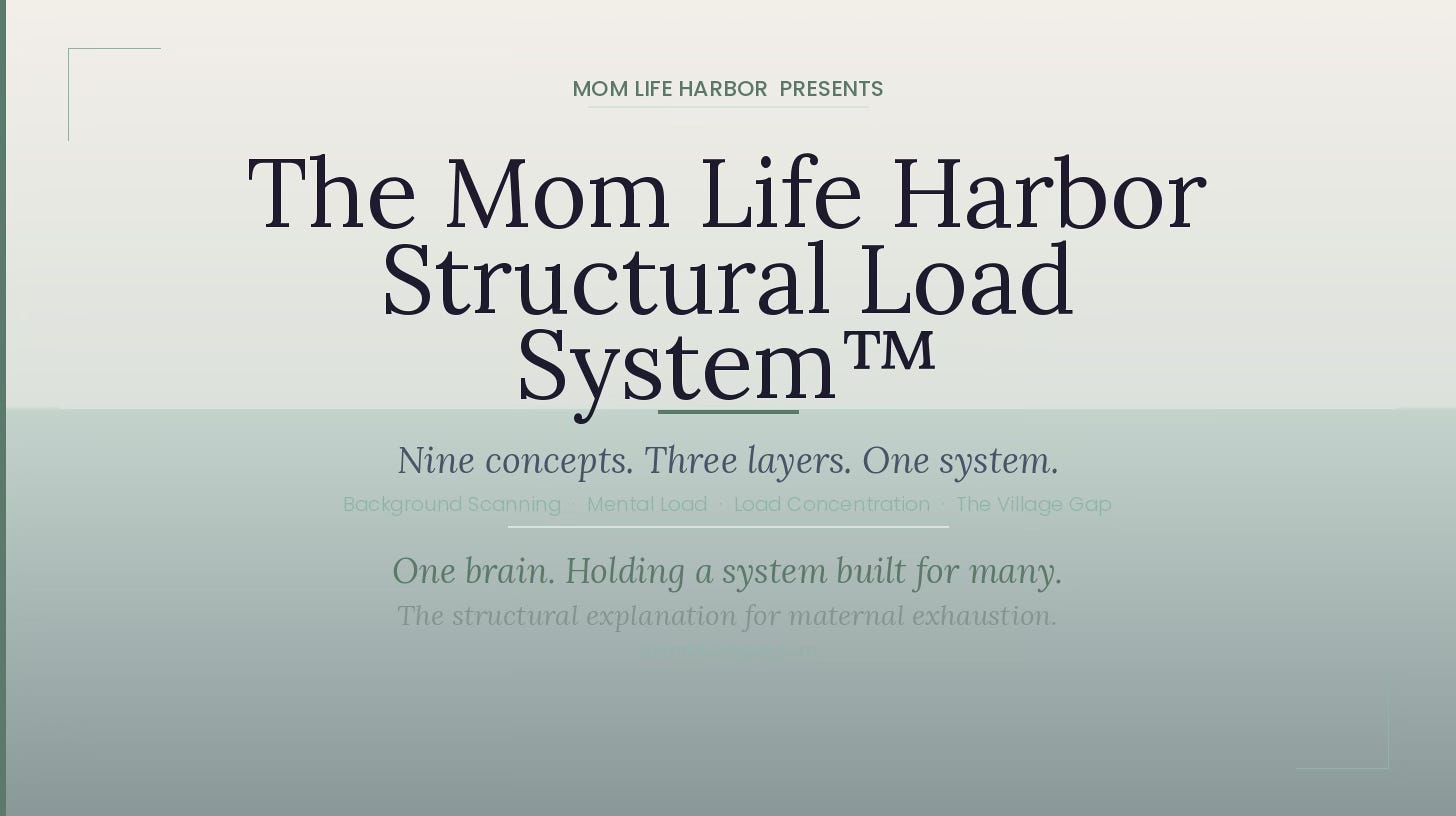
A structural map of what is happening beneath maternal exhaustion
There is a kind of tired that does not respond to rest.
It is not caused by a hard day. It persists through easy ones. It does not resolve with sleep, help, or a cleared schedule.
It exists underneath all of those things—running continuously, without a scheduled end.
Most explanations locate the cause inside the mother.
This framework does not.
The exhaustion is structural.
It is the predictable outcome of a system in which one brain holds more coordination responsibility than it was designed to carry alone.
Not a mood. Not a phase. Not a failure of effort or organization.
A design problem.
Design problems can be named.
This system is organized across three layers.
Each layer describes a different dimension— what is felt, how the load concentrates, and the conditions that made that concentration inevitable.
Layer 1 — Human Experience
What is felt before there is language for it
Background Scanning — the continuous low-level monitoring that runs beneath every activity, including rest.
Mental Load — the cognitive work of managing what needs to happen before it happens.
Invisible Coordination Work — the planning, tracking, and logistical maintenance that leaves no visible record.
These are not personality traits.
They are responses to a structural condition.
Layer 2 — System Mechanics
How the load becomes concentrated
The Routing System — the default pathway that directs questions, decisions, and problems to one person.
The Routing Effect — the compounding pressure created by the accumulation of thousands of small routing events over time.
Load Concentration — the condition in which most coordination becomes centralized in one brain.
Coordination Saturation — the point at which the system reaches capacity and one more input produces a response that appears disproportionate.
Structural Overload — the outcome: more coordination than one brain can sustainably carry, absorbed continuously.
The question did not land on an empty surface. It landed on a system that was already full.
Layer 3 — Environmental Context
Why the system has no structural outlet
The Village Gap — the absence of distributed support structures that previously shared coordination across multiple people.
Without distribution, load concentrates.
This is not nostalgia.
It is a structural explanation for why individual effort cannot resolve what is fundamentally a distribution problem.
Nine concepts. Three layers. One system.
None of this requires a wrong choice. None of it reflects effort, worth, or capacity.
It is the architecture.
The architecture is knowable.
One brain. Holding a system built for many.
The Mom Life Harbor Invisible Load Map™ is the visual companion to this system—a single-page map designed for reference, clarity, and return.
Each concept is explored in depth, one at a time.
Karleen Mom Life Harbor Making invisible cognitive labor visible